E-commerce Website Development Company in India
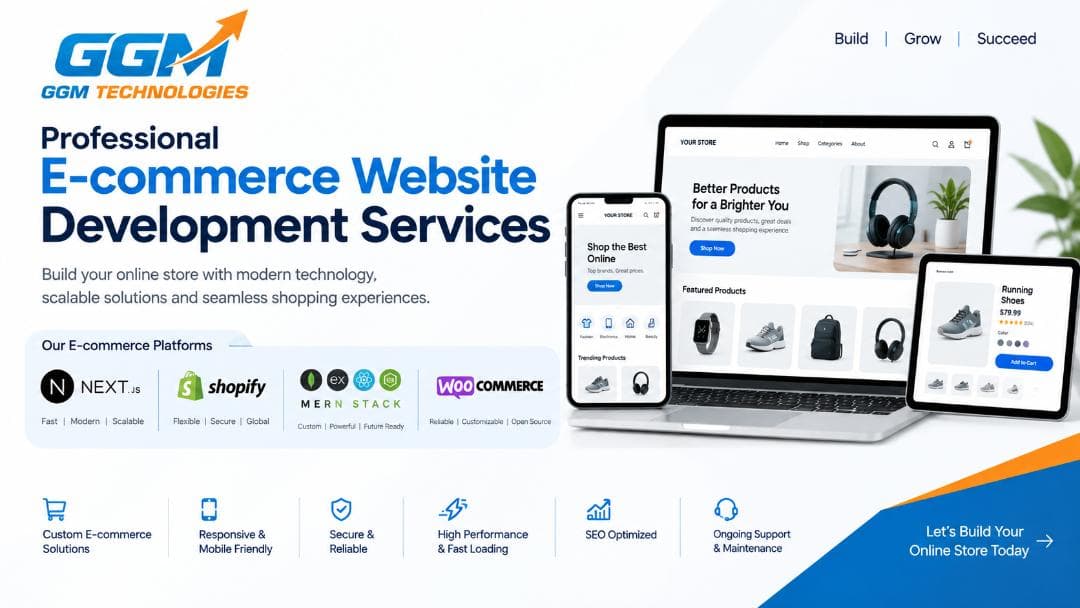
GGM Technologies builds online stores for Indian businesses on Shopify, WooCommerce and custom platforms. You get a store that is easy for customers to buy from, easy for your team to manage, and set up so Google can find your products.
We help with the full job: store design, product upload, payment and shipping set-up, and the SEO groundwork that most agencies leave until later.
Instant Pricing for E-commerce Website Development
Leave your name & phone. We'll call with custom scope & price in 15 mins.
Who needs an online store
You may need an online store if you sell products and want customers to order directly, instead of through WhatsApp messages or marketplaces that take a cut and own the customer relationship. It also suits manufacturers and wholesalers who want a catalogue with online ordering.
Some businesses start with a small Shopify store and move to a custom platform later. Others need a custom store from day one. We help you choose based on your products and your plans, not on what is easiest for us to build.
E-commerce development services we offer
Shopify stores
A hosted platform that is quick to launch and easy to manage. A good fit for most brands that sell a defined range of products and want low technical upkeep.
WooCommerce stores
An online store on WordPress, suited to businesses that want more control over design and plugins, or already run a WordPress site.
Custom e-commerce development
A store built from scratch on Next.js and a database, for businesses with unusual products, pricing rules, B2B ordering or integrations that platforms cannot handle.
Payment gateway and checkout set-up
We help you choose a payment gateway and connect it, including UPI, cards, net banking and cash on delivery where it makes sense, then test the full checkout.
Shipping and order management
Courier and shipping rate integration, order status emails, GST invoices and returns handling, so the work after the sale runs smoothly.
Product upload and catalogue set-up
Bulk upload of products, variants, categories and images, with clean URLs and descriptions ready for search.
E-commerce SEO and migration
Category and product page optimisation, product schema and redirects. If you are moving from another platform, we protect the rankings you already have.
E-commerce Website Development pricing guide
Store prices depend on the platform, the number of products and the features you need. The factors below explain what moves the price up or down.
What affects the cost of an online store
Platform
Shopify has monthly subscription fees and app costs, WooCommerce needs hosting and plugins, and a custom store needs the most build time. We compare the full cost over time, not just the build price.
Number of products and variants
Fifty products with a few variants is a simple job. Thousands of SKUs with sizes, colours and stock rules need bulk upload tools and more testing.
Design
A customised theme is cheaper than a fully custom design. Strong product photography often matters more to sales than design flourishes.
Payments, shipping and tax
Gateway fees, courier integrations, GST invoicing and cash on delivery rules all need set-up and testing.
Integrations
Connecting to accounting software, inventory systems, a CRM or WhatsApp adds build time and ongoing checks.
Marketing and SEO
Launching a store is the start. Budget for SEO, product content and ads, because new stores do not get traffic on their own.
Our e-commerce development process
We build stores in six steps. You approve the key decisions before we move on.
- 01
Discovery and platform choice
We learn what you sell, how many products you have and how you ship. Then we recommend Shopify, WooCommerce or a custom build, with the reasons.
- 02
Store structure and design
We plan categories, navigation, product page layout and checkout, and design the key pages for mobile first.
- 03
Build and product upload
We build the store, then upload products with images, variants and descriptions. You can review it on a private link.
- 04
Payments, shipping and tax set-up
We connect the payment gateway, shipping rates, tax settings and order emails, then run test orders from start to finish.
- 05
Testing and SEO set-up
We test on phones and browsers, check speed, and set up titles, descriptions, product schema, sitemap and analytics.
- 06
Launch and training
We take the store live, set up redirects if you are moving from another site, and train your team to manage products and orders.
Technology we use
Platforms
- Shopify
- WordPress
- Next.js
Back end and database
- Node.js
- MySQL / MariaDB
Hosting and delivery
- Cloudflare
- Nginx
Tracking
- Google Tag Manager
- Google Search Console
- Microsoft Clarity
Recent store projects
Shopify Website Development - Vivek Patel Studio
Mr. Vivek Patel
The primary objective is to design and develop a modern, premium, and conversion-focused Shopify website for Vivek Patel Studio that reflects the brand’s identity, showcases its products and collections in an engaging manner, and provides customers with a smooth and user-friendly shopping experience
Why choose GGM Technologies
We advise on the platform, not just build
Shopify, WooCommerce and a custom store suit different businesses. We explain the trade-offs and costs before you commit.
SEO planned from the start
Product pages, categories, schema and redirects are set up during the build, so the store is ready to be found when it launches.
Developers and SEO under one roof
The same team that builds the store can fix technical SEO problems and speed issues, with no hand-offs between vendors.
Based in New Delhi
You can call, meet or video-call the team. We work in English and Hindi.
How to choose an e-commerce development company
1. Ask for a platform comparison
A good agency explains the cost and trade-offs of Shopify, WooCommerce and custom builds, instead of pushing the one it prefers.
2. Look at live stores
Open their stores on your phone and place a test order if you can. Check speed, search, filters and checkout.
3. Check payments and shipping experience
Ask which payment gateways and courier services they have connected, and who tests the full order flow before launch.
4. Ask about product data and SEO
Category pages, product titles, schema and clean URLs should be planned from the start, since fixing them later is slow and costly.
5. Own your store and customer data
The store account, domain and customer and order data should be yours. Confirm this in writing.
6. Plan for support after launch
Ask who handles plugin updates, security and problems on sale days, and what that costs each month.
E-commerce Development FAQs
How much does an e-commerce website cost in India?
The price depends on the platform, the number of products and the features. A small Shopify store costs much less than a custom marketplace.
We give a written quote after a discovery call, and we show ongoing costs too, such as subscription fees and gateway charges.
Which is better for my store: Shopify, WooCommerce or custom?
Shopify suits most small and mid-size stores: quick to launch, secure, and low maintenance. WooCommerce gives more control and no platform subscription, but needs more upkeep.
A custom store makes sense for complex pricing, B2B ordering or unusual integrations. If you are unsure, start with a short call and we will recommend one.
How long does it take to build an online store?
The biggest factor is how soon your product data and photos are ready. Stores with ready catalogues launch much faster.
Which payment methods can my store accept?
Indian payment gateways can handle UPI, debit and credit cards, net banking and wallets, and most stores also offer cash on delivery. We help you pick a gateway based on fees, settlement time and the methods your customers use.
Will my store show up on Google?
We set up clean URLs, product and category page titles, product schema, a sitemap and fast loading. That gives your products a fair start.
Ranking for competitive product searches also needs content and links over time, which we offer as ongoing e-commerce SEO.
Who owns the store and its data?
You should own the domain, the store account and your customer and order data. Set up your Shopify or hosting account in your own name.
Can you move my store from another platform?
Yes. We export your products, customers and orders, rebuild them on the new platform, and set up 301 redirects from old product and category URLs, so you keep your search rankings.
What does it cost to run an online store each month?
Ongoing costs include the platform subscription or hosting, payment gateway fees, any paid apps or plugins, and optional maintenance and marketing.
Do you handle GST invoices and shipping integration?
We can set up GST-ready invoices and connect courier and shipping rate services, so orders flow from checkout to dispatch with less manual work.
What are your payment terms?
Most store projects are paid in stages that match approved milestones, such as design sign-off, a working store with test orders, and launch.
Tell us about your store
Tell us what you sell and roughly how many products you have. We will recommend a platform and send a written quote.
Where we work and what to read next
E-commerce Website Development by city
E-commerce Website Development by state and country
- Delhi (252)
- Maharashtra (202)
- Uttar Pradesh (189)
- Karnataka (150)
- United States (77)
- Haryana (74)
- Gujarat (66)
- United Arab Emirates (48)
- United Kingdom (34)
- Tamil Nadu (31)
- Telangana (24)
- Bihar (21)
- Canada (21)
- Bahrain (19)
- Rajasthan (19)
- Saudi Arabia (19)
- West Bengal (19)
- Madhya Pradesh (15)
- Oman (15)
- Australia (14)
- Punjab (14)
- Kerala (13)
- Uttarakhand (12)
- Kuwait (11)
- Andhra Pradesh (10)
- Jordan (9)
- Germany (7)
- India (7)
- Malaysia (7)
- Qatar (7)
- Chandigarh (6)
- Himachal Pradesh (6)
- Jharkhand (6)
- Odisha (6)
- Chhattisgarh (5)
- Goa (5)
- Netherlands (5)
- New Zealand (5)
- South Africa (5)
- Assam (4)
- Singapore (4)
- Indonesia (3)
- Ireland (3)
- Switzerland (3)
- Thailand (3)
- Belgium (2)
- Brazil (2)
- Dadra and Nagar Haveli and Daman and Diu (2)
- Delhi-NCR (2)
- Egypt (2)
- Finland (2)
- France (2)
- Israel (2)
- Italy (2)
- Jammu and Kashmir (2)
- Japan (2)
- Mauritius (2)
- Morocco (2)
- Nagaland (2)
- Norway (2)
- Philippines (2)
- Poland (2)
- Spain (2)
- Sweden (2)
- Turkey (2)
- Andaman and Nicobar Islands (1)
- Arunachal Pradesh (1)
- Austria (1)
- Caribbean (1)
- Czech Republic (1)
- Denmark (1)
- Dubai (1)
- Europe (1)
- Hong Kong (1)
- Ladakh (1)
- Luxembourg (1)
- Malta (1)
- Manipur (1)
- Meghalaya (1)
- Mexico (1)
- Mizoram (1)
- North America (1)
- Portugal (1)
- Puducherry (1)
- Sikkim (1)
- Sri Lanka (1)
- Tripura (1)